Ground segment nominal UTC ----.--.-- --:--:--

Engineering notes

Field notes from the Helion team: what we measured, what broke, and what we changed as a result. Written by the engineers who did the work, published when there is something worth reading.

Most entries here start from an operator question we could not answer from the platform itself, and end with a change we shipped. We publish the method along with the number, because a baseline without a method is an anecdote with a decimal point.

Featured

Telemetry baselines for 2026

A year of aggregate ingest telemetry across the Helion network, reduced to the numbers that describe how small satellite operators actually fly: battery margins under load, downlink budgets per pass, and how often a planned pass is lost to something other than weather.
2026-01-14Marit Halldorsdottir14 min read
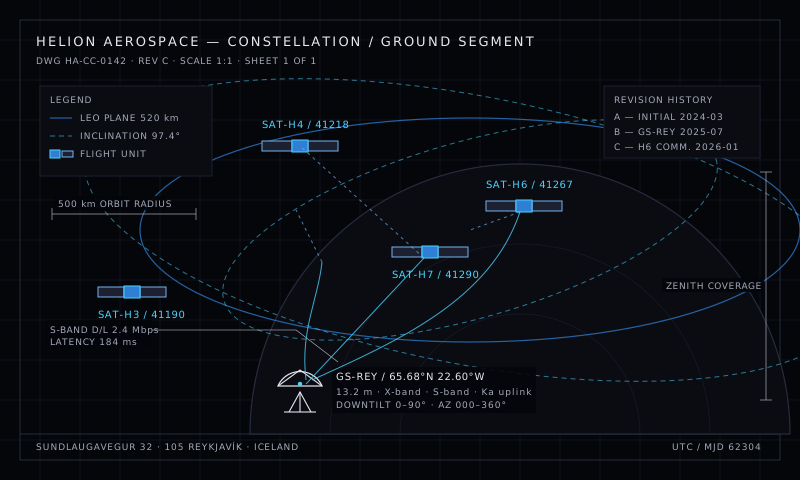
Constellation schematic with orbital planes and ground stations

All notes

Ordered by publication date. Older notes are kept because the problems they describe have not gone away.

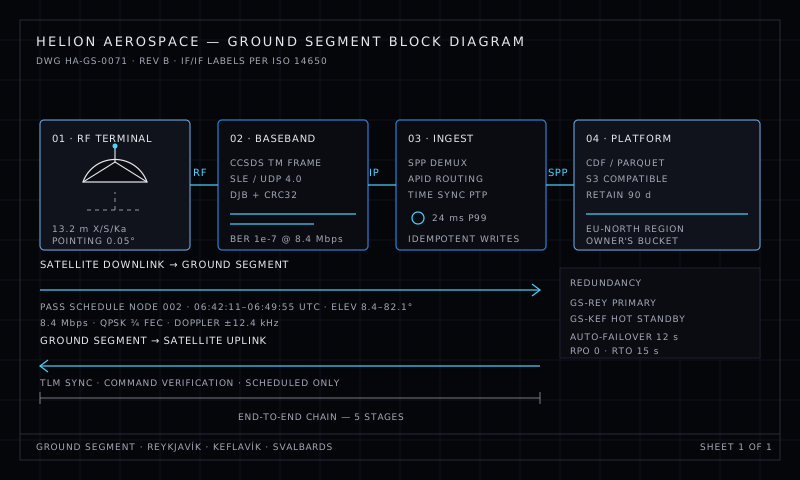
Ground segment block diagramIngest

Decoding CCSDS space packets without losing the gaps

How the ingest edge splits primary headers from secondary headers, why an unmapped APID goes to quarantine instead of the void, and how the sequence counter becomes a gap record you can plot.

2025-11-03Jonas Thordarson
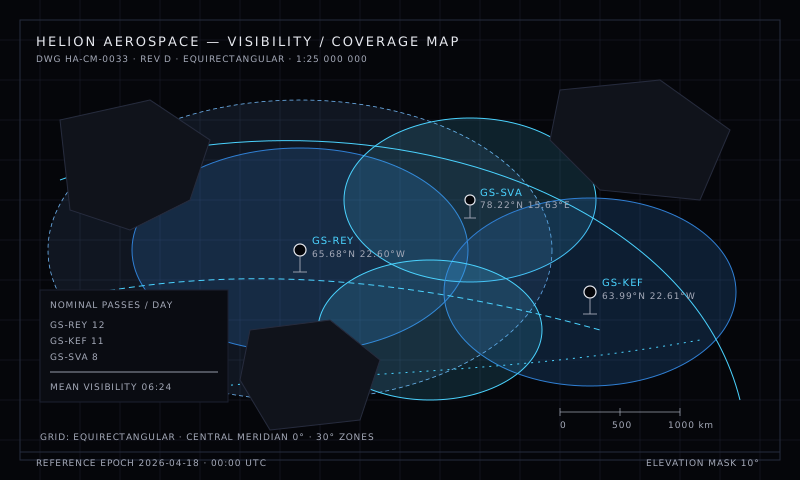
Coverage map with visibility zonesPlanning

Planning a week of passes that survives a missed window

Building the schedule so that losing one pass costs an operator a delay rather than a day. Contact windows, downlink priorities and the overlap arbitration rule.

2025-09-22Elin Sigurdardottir
Constellation schematicPerformance

What 3.1 billion packets taught us about ingest latency

The median says 190 milliseconds. The tail is where the engineering lives. A look at how we measure the edge-to-queryable path and what we did about the slowest one percent.

2025-06-11Marit Halldorsdottir
Ground segment block diagramStorage

CDF, CSV, Parquet: choosing the archive format honestly

Each format answers a different question. We describe when the choice of archive format matters, and when the honest answer is that it does not yet.

2025-03-27Rasmus Benediktsson
Coverage map with visibility zonesProtocols

SLE, CFDP and the case for boring protocols

Space Link Extension is forty years old and still does exactly what a small operator needs at four in the afternoon. Notes on running it alongside CFDP file delivery.

2024-12-09Jonas Thordarson
Ground segment block diagramReliability

Measuring availability where the antenna is the weak link

An SLA that measures the wrong segment is worse than no SLA. How we attribute downtime between station, uplink and platform, and what we promise as a result.

2024-10-15Elin Sigurdardottir

Editorial policy

Every entry is written by a member of the Helion team and reflects work we did. We do not accept guest posts that promote a product, and we do not publish a benchmark without the method that produced it. Where an entry draws on operator data, the aggregation is described and no individual spacecraft is identifiable in the published figures.

Corrections are made openly. If a published number turns out to be wrong, the entry is corrected with a dated note at the top explaining what changed. We have done this twice, both times for a transcription error in a percentile calculation, and both times the correction note remains visible.

Getting notified

New entries are announced by email to a list we keep deliberately small. There is no tracking pixel and no third-party analytics on this site, so we cannot tell whether you opened anything, and we do not try to. If you would rather not receive it, the unsubscribe link is in every message and removes you from the list immediately.

We also publish a plain-text digest, roughly quarterly, to anyone who asks for it. The digest contains the entries from the period and nothing else — no product announcements, no events, no tracking. Ask through the contact form and we will add you.

No tracking pixels Plain-text digest Open corrections

Series

Longer threads we keep updating as the measurements change.

Ongoing

Network baselines

Annual aggregates of ingest latency, gap rate and downlink throughput across the Helion ground segment. The 2026 edition is published; the 2025 edition is kept for comparison.

2 editionsUpdated yearly
Read the 2026 edition
Ongoing

Small operator notes

Practical write-ups from operators running one or two spacecraft: how they structure ground passes, what they log, and which parts of the process they would keep if they had to do it again.

Guest posts6 contributors
Propose a topic

Read the platform first

The notes assume a working knowledge of ingest and planning. The product pages cover the mechanics, and the documentation covers the API.