Ground segment nominal UTC ----.--.-- --:--:--

Company

Helion Aerospace ehf. is an Icelandic software company operating the ingest and planning layer for small satellite operators. We are twenty-three people in Reykjavík, and we run the ground segment ourselves.

Why we exist

The small satellite operator has been underserved by the space software industry, and not by accident. The large platform products assume a dedicated ground segment team, a budget for licensed tooling and a procurement process measured in quarters. A two-person team flying three spacecraft has none of those, and has been solving the problem with a spreadsheet, a shared drive and a great deal of patience.

That patience is the resource we are trying to replace. Someone on every small operation is maintaining knowledge that only exists in their head — which parameter is which APID, how long the acquisition really takes, when the battery plateaus. When that person is on holiday, the operation is degraded, and when they leave, it stops.

Helion exists to make that knowledge explicit, versioned and queryable. Not as a platform strategy, but as a straightforward piece of infrastructure: the sort you would expect to be boring, well documented and available at a price a small operator can afford.
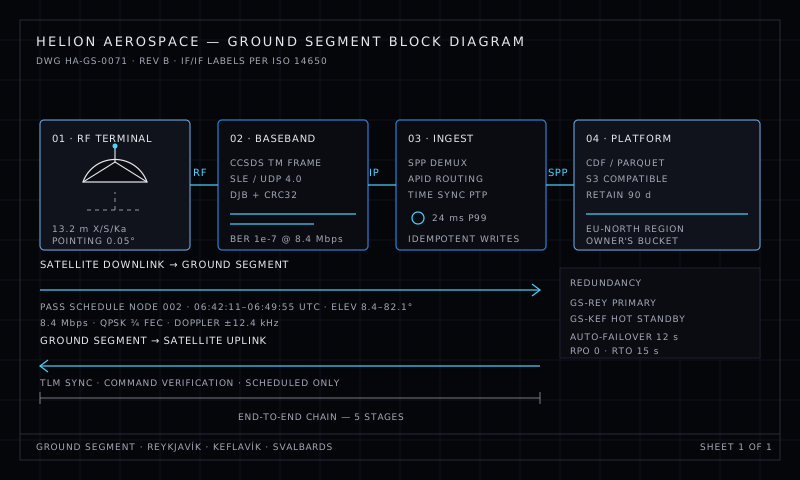
Ground segment block diagram of the Helion platform
Fig. 1 — The ground segment we operate, as deployed in 2025.

History

Six years, four stations and one decision to stay small.

Team

Twenty-three people, of whom these six lead the engineering and operations work.

KH

Katrín Hjálmarsdóttir

Chief Executive

Co-founder. Previously an operations analyst on a two-satellite Earth observation mission, which is where the first spreadsheet came from. Handles the commercial side and the parts of the company that require remembering who promised what.

JT

Jónas Þórðarson

Chief Technology Officer

Co-founder. Wrote the original CCSDS decoder and still reviews the ingest edge on the first Thursday of every month. Responsible for the decoder being the boring, well-tested part of the system rather than the interesting one.

ES

Elín Sigurðardóttir

Head of Ground Segment

Runs the four stations and the availability measurement behind the SLA. Spent eight years in satellite operations before joining and has strong opinions about acquisition margins and about writing down why a pass was lost.

MH

Marít Halldórsdóttir

Head of Data Platform

Owns the ingest edge, the storage layer and the baselines series. Publishes the annual telemetry baselines and is responsible for the claim that a gap is recorded rather than hidden.

RB

Rasmus Benediktsson

Head of Flight Systems

Leads the Mission Control work: window computation, the command queue and the approval model. Came from an operator background and builds features by asking what an operator would want to happen at three in the morning.

GA

Guðrún Ákadóttir

Head of Support and Security

Runs support, the security programme and the compliance work behind the ISO 27001 certification. Believes a support response time is a product feature and should be measured like one.

Office

One office, four stations, twenty-three desks' worth of people.

Our office is at Sundlaugavegur 32, 105 Reykjavík, in the old harbour-side industrial district south of the city centre. The building is a converted print works with high ceilings and windows that face the sea, which matters more than it sounds when the midwinter light runs out at four in the afternoon.

The engineering floor is on the second level and the ground segment operations desk is on the ground floor, next to the entrance. They are deliberately close together. An operator watching a pass from the operations desk can walk to an engineer's desk in twenty seconds, and that has been worth more than any amount of tooling.

Ground stations

GS-REY
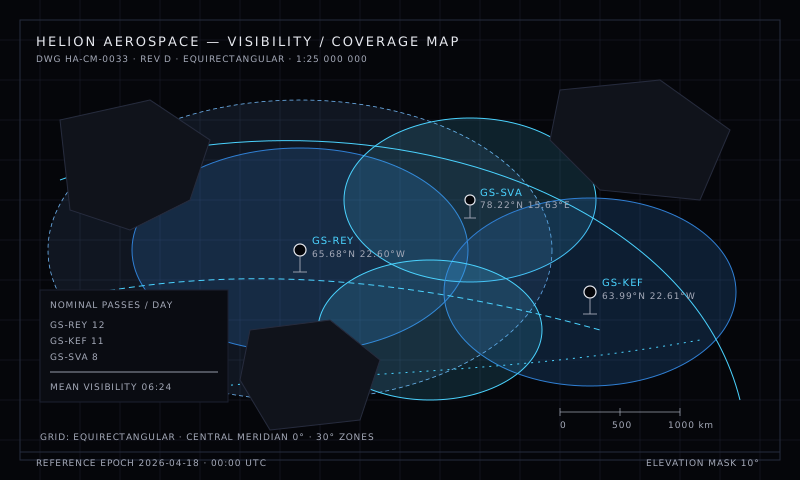
Reykjavík, 65.68°N 22.60°W. 13.2 m X/S/Ka antenna. Primary site.
GS-KEF
Keflavík, 63.99°N 22.61°W. 4.5 m S-band with X-band feed. Hot standby for GS-REY.
GS-SVA
Svalbard, 78.22°N 15.63°E. 7.3 m S-band. High-inclination coverage.
GS-LEI
Leased slot, 47.45°N 19.04°E. 3.7 m S-band. Third-party facility.
Visibility map showing the four Helion ground station locations
Fig. 1 — Station locations and the visibility zones they produce.
Automatic failover. If GS-REY does not acknowledge a scheduled acquisition within twelve seconds, the pass is handed to GS-KEF. The failover is automatic because a manual failover loses the pass.

Visiting

Visitors are welcome by arrangement. The ground segment operations desk is the interesting part if you are visiting for operational reasons, and there is a coffee machine that works better than any of them do. Write to hello@helionhq.link before coming and we will arrange a time.

Open roles

We hire slowly and keep people a long time. These positions are open as of January 2026.

Apply →
Engineering

Senior Flight Software Engineer

Ingest edge and decoder work in Rust and Go, with the occasional need to reason precisely about a bit field. You have worked with CCSDS framing in anger rather than in a paper.

Full-timeReykjavík or remote (EU)
Engineering

Ground Segment Operator

Station operations, pass scheduling and the human side of anomaly response. Some on-call, shared with a small team. Familiarity with S-band and X-band chains and the willingness to work shifts.

Full-timeReykjavík
Product

Technical Support Engineer

Second and third line support for operators running real spacecraft. Comfortable reading a spec and reading a log, and able to tell the difference between the two when an operator is stressed.

Full-timeRemote (EU)
Platform

Site Reliability Engineer

The ingest edge and the storage layer, with an emphasis on measurement rather than on heroics. Terraform, Kubernetes and a genuine interest in what a latency percentile means.

Full-timeReykjavík or remote (EU)

Nothing that fits? Write to hello@helionhq.link with what you would want to work on. We read everything and we answer.

How we work

Four commitments that show up in the product whether or not we want them to.

01

Measure before promising

Every availability and latency figure we publish comes from the same measurement we use internally. If we cannot attribute a failure, we do not claim a number for it.

02

Record, do not hide

Missing data is recorded as missing. A gap with a duration and a cause is more useful than a continuous-looking chart that quietly omits an hour.

03

Standards, not dialects

We implement published standards and document precisely where a spacecraft departs from them. Compatibility with a non-standard frame is a feature of the registry, not a fork of the decoder.

04

Leave when you want to

Your data exports to your bucket, in an open format, with no export fee. A platform you cannot leave is a platform that does not have to be good.

Come and see the operations desk

If you are evaluating the platform, a visit is worth more than a demo. Bring your elements and we will plan against them.